


What Is Witchcore? The Complete Aesthetic Guide
Witchcore isn't a trend. It's a lineage. Where it comes from, what it looks like, and how to wear it without looking like Halloween.
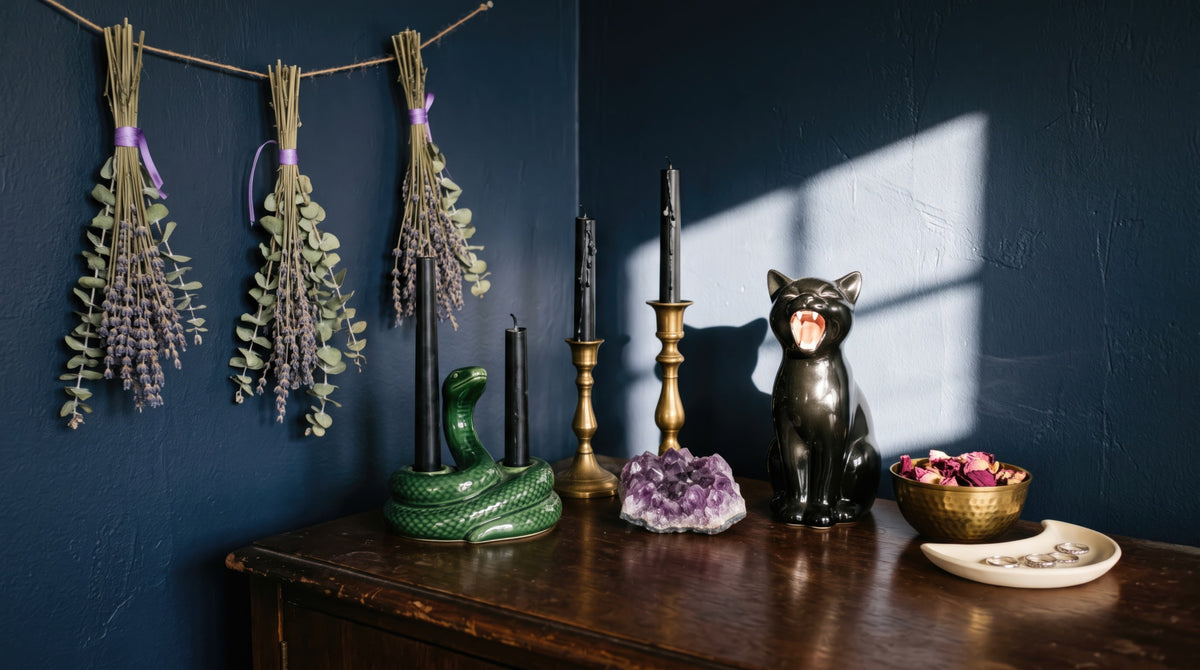
Witchcore is having a moment. Or more accurately, witchcore has always been happening, and more people are finally finding the language for something they already were. That's how it usually goes with aesthetics that are actually identities rather than trends. The trend people find it late. The identity people were already there, slightly annoyed by the sudden company, but willing to make room for the ones who are here for the right reasons.
This is the complete guide to witchcore. Where it comes from. What it looks like. How to live it without looking like you grabbed it off a discount rack in October. (If you read our Counterculture Style Guide, consider this the deep dive.)
THE HISTORY: SHE HAS ALWAYS BEEN HERE
The witch, as a cultural figure, is ancient. She predates any current aesthetic by centuries. She has always represented the woman who existed outside the structures men built and maintained: the healer who worked with plants and knowledge instead of credentials, the woman who lived alone and answered to nobody, the figure who claimed power through means the official channels didn't sanction and couldn't control.
The historical witch trials across Europe and colonial America were, examined honestly, largely the persecution of inconvenient women. Healers. Widows who owned property. Women who were too old, too poor, too solitary, too outspoken, or too anything that someone with power found threatening. The witch as archetype carries all of that history. She is not a Halloween character. She is a lineage.
Modern witchcore pulls from Victorian mourning culture, folk magic traditions, Romanticism, Gothic literature, and the feminist spirituality movements of the 1970s. It synthesizes everything that has ever been coded dark and feminine and powerful at the same time, and it refuses to apologize for any of it.
THE VISUAL LANGUAGE
Witchcore has one of the most specific visual vocabularies of any current aesthetic. The palette centers on black, deep forest green, midnight blue, burgundy, and the particular grey of aged silver. Natural materials dominate. Raw linen. Velvet with a history. Worn leather. Unpolished stone. Anything that suggests the natural world in its darker, stranger register.

The motifs come from folk magic and nature: moons in every phase, botanical illustrations, skulls and bones, crows, serpents, hourglasses, antlers, moths, spiders. Everything is chosen because it means something. A raven is not just a bird. A spider web is not just a print. If you're assembling a witchcore wardrobe and can't say why you chose a specific piece, dig deeper before you buy it.
Silhouettes are layered, slightly oversized, and built to move. Long skirts. Flowing sleeves. Capes. Anything that behaves dramatically in wind. The effect should suggest someone who exists just slightly outside linear time and dresses by an internal logic that predates current trends by a meaningful margin.
WITCHCORE VS. GOTH: A NECESSARY DISTINCTION
These two overlap constantly and get confused by people new to both. The difference is tone, reference, and origin. Goth came out of post-punk music culture in the late 1970s and early 1980s. Bauhaus. Siouxsie and the Banshees. The Cure. It's rooted in cities, in clubs and industrial landscapes, in the electricity of a music scene doing something genuinely new.
Witchcore is older, more rural, more tied to the natural world and folk practice. Goth is a nightclub at 2am. Witchcore is a forest at midnight. Both deal in darkness, but different kinds. You can be both, and plenty of us are, but knowing the difference makes you better at each.
BUILDING THE WARDROBE WITHOUT LOOKING LIKE HALLOWEEN
Start with black that has actual weight and texture. Not cheap polyester black, which reads as costume from across the room. Velvet black. Heavy linen black. Cotton washed enough times to soften properly. The quality of your black is foundational. Get this right and everything else gets easier.
Layer with intention. A linen shirt under a velvet vest under a heavy cardigan is not three pieces awkwardly stacked. It's a composition. It should look effortless in the way things only look effortless after plenty of practice. Put in the practice.

Build your accessories slowly. Real witchcore jewelry is never bought as a matching set. It's collected over time from sources that take effort to find. An estate sale ring. A pendant you've worn so long it's part of your silhouette. A cuff from an independent silversmith. The accumulation tells a story no single shopping trip can fake.
Choose symbols that actually mean something to you. A pin on a jacket is not decoration. It's a statement of allegiance. Choose your allegiances carefully.
WITCHCORE IN THE HOME
The aesthetic moves naturally into your space. Deep-toned walls. Heavy textiles. Collections of natural objects assembled with obvious care. Candlelight doing the work overhead lighting never should have been trusted with. Art that means something rather than just matching the throw pillows.

The witch's home is functional and beautiful at once. Dried herbs hang from the ceiling because they're beautiful and because they actually get used. Candles are everywhere because atmosphere isn't optional. Nothing is purely decorative. Everything serves. Our Where the Witch Things Are collection was built for exactly this kind of space.
SHOP THE COVEN
Pieces for the witch who collects slowly and means every one of them.


